
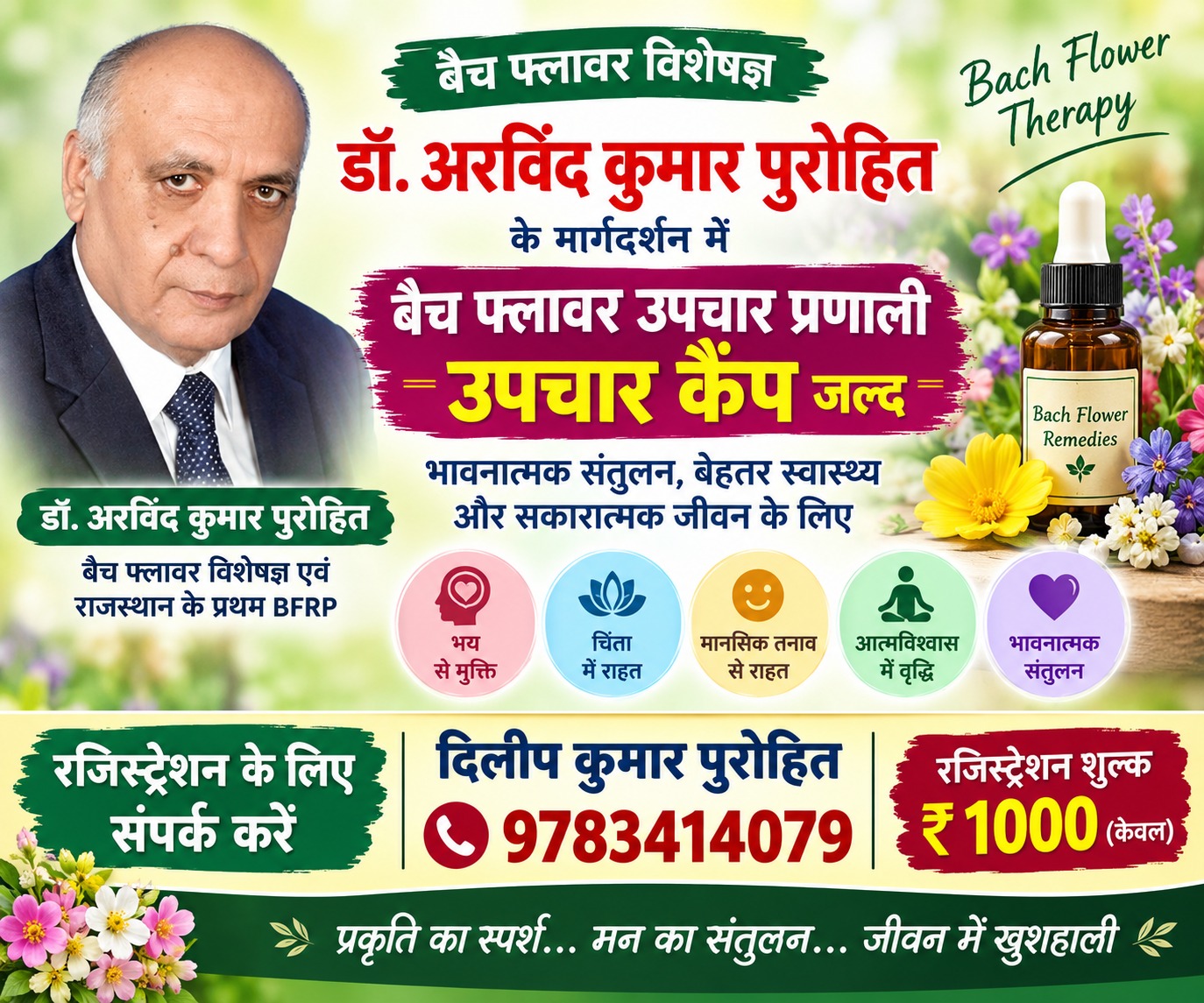
जोधपुर में बैच फ्लावर विशेष डॉ. अरविंद कुमार पुरोहित का चिकित्सा कैँप जल्द, तैयारियां शुरू, रजिस्ट्रेशन शुरू
उदित भास्कर. जोधपुर
मनुष्य का जीवन केवल शरीर से नहीं, बल्कि उसकी भावनाओं, विचारों और व्यवहार से भी प्रभावित होता है। कभी हम बिना किसी स्पष्ट कारण के उदास हो जाते हैं, कभी छोटी-सी बात से घबरा जाते हैं और कभी दूसरों को प्रसन्न रखने के लिए अपनी इच्छाओं को पीछे छोड़ देते हैं। कई बार चेहरे पर मुस्कान होती है, लेकिन मन के भीतर चिंताओं का तूफान चल रहा होता है।
ऐसी ही भावनात्मक अवस्थाओं को समझने के लिए इंग्लैंड के चिकित्सक डॉ. एडवर्ड बैच ने बैच फ्लावर रेमेडीज की एक विशेष प्रणाली विकसित की। उन्होंने शुरुआत में 12 प्रमुख पुष्प उपचारों की पहचान की, जिन्हें Twelve Healers यानी बारह हीलर्स कहा गया। इनका विकास मुख्य रूप से 1920 के दशक के अंतिम वर्षों और 1930 के दशक के शुरुआती वर्षों में हुआ।
डॉ. बैच की विचारधारा में प्रत्येक व्यक्ति का अपना स्वभाव, सोचने का तरीका और भावनात्मक संसार होता है। उनके अनुसार, कुछ विशेष भावनात्मक प्रवृत्तियों को 12 हीलर्स के माध्यम से समझा जा सकता है। इन पुष्प उपचारों को उन्होंने मन की नकारात्मक भावनाओं के सकारात्मक रूप की ओर बढ़ने के एक माध्यम के रूप में प्रस्तुत किया। इस लेख में हम इन 12 हीलर्स को सरल भाषा में समझेंगे। प्रत्येक पुष्प के साथ उससे जुड़ी प्रमुख भावनात्मक अवस्था, उसके व्यवहार में दिखाई देने वाले संकेत और सकारात्मक बदलाव की दिशा पर चर्चा करेंगे।
1. एग्रीमनी (Agrimony) : मुस्कान के पीछे छिपी चिंता :
एग्रीमनी उन लोगों से संबंधित है जो बाहर से हंसमुख, मिलनसार और प्रसन्न दिखाई देते हैं, लेकिन अपने मन की परेशानियों को दूसरों से छिपाकर रखते हैं। वे अक्सर नहीं चाहते कि कोई उनके दुख या चिंता को पहचाने। ऐसे लोग कभी-कभी अपनी परेशानी से बचने के लिए लगातार व्यस्त रहते हैं, मजाक करते हैं या हर परिस्थिति में खुश दिखाई देने का प्रयास करते हैं। उन्हें लगता है कि अपनी तकलीफ बताने से दूसरे लोग परेशान होंगे या उनकी छवि प्रभावित होगी। इस भावनात्मक अवस्था में अपने मन की बात स्वीकार करना और किसी विश्वसनीय व्यक्ति से साझा करना महत्वपूर्ण हो सकता है। एग्रीमनी का पारंपरिक सकारात्मक संदेश है कि सच्ची प्रसन्नता का अर्थ दुख को छिपाना नहीं, बल्कि अपनी भावनाओं को सहजता से स्वीकार करना भी है।
मुख्य भाव : दिखावटी प्रसन्नता और भीतर छिपी चिंता।
2. सेंटॉरी (Centaury) : दूसरों के लिए अपनी इच्छाएं भुला देना
सेंटॉरी उन लोगों की भावनात्मक प्रवृत्ति से जुड़ा है जो दूसरों की मदद करने के लिए हमेशा तैयार रहते हैं। वे किसी को नाराज नहीं करना चाहते और इसलिए कई बार ऐसे काम भी स्वीकार कर लेते हैं जिन्हें करने की उनकी इच्छा नहीं होती। ऐसे व्यक्ति दूसरों की बात आसानी से मान लेते हैं। उन्हें मना करने में संकोच होता है और वे अपनी जरूरतों, समय तथा आराम की उपेक्षा कर सकते हैं। धीरे-धीरे यह आदत उन्हें मानसिक थकान और असंतोष की ओर ले जा सकती है। इस अवस्था का सकारात्मक पक्ष है अपनी इच्छाओं और सीमाओं का सम्मान करना। दूसरों की सहायता करना अच्छी बात है, लेकिन अपनी जरूरतों को पूरी तरह भुला देना आवश्यक नहीं। विनम्रता के साथ अपनी बात कहना और जरूरत पड़ने पर मना करना भी आत्मसम्मान का हिस्सा है।
मुख्य भाव : दूसरों के प्रभाव में आकर अपनी इच्छाओं को दबा देना।
3. सेराटो (Cerato) : अपने निर्णयों पर संदेह
सेराटो उन लोगों की भावनात्मक स्थिति से संबंधित है जिन्हें अपने निर्णयों पर भरोसा करने में कठिनाई होती है। वे किसी निर्णय पर पहुंचने के बाद भी बार-बार दूसरों से पूछते हैं कि उन्होंने सही फैसला किया है या नहीं। ऐसे व्यक्ति के पास जानकारी और समझ होने के बावजूद अपने विवेक पर विश्वास कम हो सकता है। वे दूसरों की सलाह को जरूरत से ज्यादा महत्व देते हैं और कई बार इसी कारण निर्णय बदलते रहते हैं। इस प्रवृत्ति में आत्मविश्वास विकसित करना उपयोगी हो सकता है। दूसरों की सलाह सुनना समझदारी है, लेकिन अंतिम निर्णय लेते समय अपनी परिस्थितियों, अनुभव और विवेक को भी महत्व देना चाहिए। छोटी-छोटी जिम्मेदारियों के निर्णय स्वयं लेना आत्मविश्वास बढ़ाने का अभ्यास बन सकता है।
मुख्य भाव : आत्म-संदेह और दूसरों से बार-बार पुष्टि मांगना।
4. चिकरी (Chicory) : प्रेम में अधिकार जताने की प्रवृत्ति
चिकरी उन भावनात्मक प्रवृत्तियों से जुड़ा है जिनमें व्यक्ति अपने प्रियजनों से बहुत अधिक लगाव रखता है, लेकिन कभी-कभी इस लगाव के साथ अधिकार जताने या उन्हें अपने अनुसार चलाने की इच्छा भी जुड़ जाती है। ऐसा व्यक्ति परिवार के सदस्यों की चिंता करता है और उनकी सहायता करना चाहता है। लेकिन जब उसकी अपेक्षाओं के अनुसार व्यवहार नहीं होता, तो वह नाराज हो सकता है या यह महसूस कर सकता है कि उसके प्रेम का उचित सम्मान नहीं किया जा रहा। इस भावनात्मक स्थिति का सकारात्मक पक्ष निस्वार्थ प्रेम और दूसरों की स्वतंत्रता का सम्मान करना है। प्रेम का अर्थ किसी को नियंत्रित करना नहीं, बल्कि उसे अपनी पसंद और निर्णयों के साथ स्वीकार करना भी है। संबंधों में विश्वास, संवाद और भावनात्मक स्वतंत्रता से निकटता मजबूत हो सकती है।
मुख्य भाव : अत्यधिक अपेक्षाओं और अधिकार भावना से जुड़ा प्रेम।
5. क्लेमाटिस (Clematis) : कल्पनाओं में खोए रहना
क्लेमाटिस उन लोगों की भावनात्मक प्रवृत्ति से संबंधित है जो अक्सर कल्पनाओं में खोए रहते हैं। वे भविष्य के सुंदर सपने देखते हैं, लेकिन कई बार वर्तमान में चल रहे कामों और परिस्थितियों पर पर्याप्त ध्यान नहीं दे पाते। ऐसे व्यक्ति रचनात्मक, कल्पनाशील और विचारशील हो सकते हैं। लेकिन जब कल्पना वास्तविक जीवन की जिम्मेदारियों से दूरी बनाने का माध्यम बन जाती है, तब पढ़ाई, कामकाज या दैनिक गतिविधियों पर असर पड़ सकता है। इस प्रवृत्ति का सकारात्मक पक्ष कल्पनाशीलता के साथ वर्तमान में सक्रिय रहना है। अपने सपनों को छोटे-छोटे लक्ष्यों में बांटना, नियमित दिनचर्या बनाना और आसपास की परिस्थितियों पर ध्यान देना उपयोगी हो सकता है। कल्पना तभी अधिक सार्थक बनती है जब उसे वास्तविक प्रयासों से जोड़ा जाए।
मुख्य भाव : वर्तमान से ध्यान हटाकर कल्पनाओं में खोए रहना।
6. जेंटियन (Gentian) : छोटी बाधाओं से निराश हो जाना
जेंटियन उन लोगों की भावनात्मक अवस्था से जुड़ा है जो किसी काम में कठिनाई या असफलता मिलने पर जल्दी निराश हो जाते हैं। उन्हें लगता है कि परिस्थितियां उनके पक्ष में नहीं हैं और आगे बढ़ना कठिन होगा। ऐसे व्यक्ति प्रयास करना चाहते हैं, लेकिन छोटी-सी रुकावट भी उनके उत्साह को कम कर सकती है। कभी-कभी वे अपनी क्षमता पर संदेह करने लगते हैं और लक्ष्य प्राप्त करने से पहले ही पीछे हटने का विचार करने लगते हैं। इस प्रवृत्ति में आशावादी दृष्टिकोण और धैर्य का अभ्यास सहायक हो सकता है। असफलता को अंतिम परिणाम मानने के बजाय उससे सीखने का अवसर समझना चाहिए। हर कठिनाई स्थायी नहीं होती और लगातार किए गए छोटे प्रयास भी धीरे-धीरे बड़े परिणाम दे सकते हैं।
मुख्य भाव : बाधाओं के कारण निराशा और उत्साह में कमी।
7. इम्पेशंस (Impatiens) : हर काम जल्दी करने की बेचैनी
इम्पेशंस उन लोगों की भावनात्मक प्रवृत्ति से संबंधित है जो जल्दी परिणाम चाहते हैं और धीमी गति से होने वाले कामों से परेशान हो जाते हैं। उन्हें दूसरों की धीमी कार्यशैली, इंतजार या बार-बार समझाने की जरूरत खल सकती है। ऐसे व्यक्ति तेज निर्णय लेने वाले और काम को शीघ्र पूरा करने वाले हो सकते हैं। लेकिन अत्यधिक जल्दबाजी के कारण वे चिड़चिड़े हो सकते हैं, दूसरों की बात बीच में काट सकते हैं या अनावश्यक तनाव महसूस कर सकते हैं। इस अवस्था का सकारात्मक पक्ष धैर्य और दूसरों की गति को स्वीकार करना है। प्रत्येक व्यक्ति की कार्यशैली अलग होती है। गहरी सांस लेना, प्रतिक्रिया देने से पहले कुछ क्षण रुकना और काम को व्यवस्थित ढंग से करना जल्दबाजी कम करने के व्यावहारिक उपाय हो सकते हैं।
मुख्य भाव : अधीरता, जल्दबाजी और चिड़चिड़ापन।
8. मिमुलस (Mimulus) : पहचाने जा सकने वाले भय
मिमुलस उन लोगों की भावनात्मक अवस्था से संबंधित है जिन्हें किसी स्पष्ट कारण या परिस्थिति से डर लगता है। उदाहरण के लिए, बीमारी का भय, अंधेरे से डर, परीक्षा का तनाव, लोगों के सामने बोलने की घबराहट या किसी विशेष परिस्थिति को लेकर चिंता। ऐसे व्यक्ति अपने भय को जानते हैं और अक्सर यह भी बता सकते हैं कि उन्हें किस बात से डर लगता है। कभी-कभी यह डर उन्हें उन कामों से दूर कर देता है जिन्हें वे वास्तव में करना चाहते हैं। इस प्रवृत्ति में आत्मविश्वास के साथ धीरे-धीरे भय का सामना करना उपयोगी हो सकता है। किसी कठिन परिस्थिति को छोटे चरणों में बांटकर उसका अभ्यास किया जा सकता है। जरूरत पड़ने पर विश्वसनीय व्यक्ति या मानसिक स्वास्थ्य विशेषज्ञ की सहायता लेना भी समझदारी है।
मुख्य भाव : ज्ञात परिस्थितियों, वस्तुओं या घटनाओं से भय।
9. रॉक रोज (Rock Rose) : अत्यधिक आतंक और घबराहट
रॉक रोज उन स्थितियों से संबंधित है जिनमें व्यक्ति अचानक बहुत अधिक डर या आतंक महसूस करता है। भय की तीव्रता इतनी बढ़ सकती है कि उसे कुछ क्षणों के लिए समझ नहीं आता कि क्या करना चाहिए। ऐसी अवस्था किसी अचानक संकट, भयावह घटना या अत्यधिक घबराहट के अनुभव में दिखाई दे सकती है। व्यक्ति का मन स्थिति को संभालने के बजाय भय पर केंद्रित हो सकता है और उसे तुरंत सहायता की जरूरत महसूस हो सकती है। इस भावनात्मक स्थिति का सकारात्मक संदेश साहस और संकट के समय स्वयं को संभालने की क्षमता विकसित करना है। सुरक्षित स्थान पर जाना, आसपास के विश्वसनीय लोगों की मदद लेना और जरूरत के अनुसार चिकित्सकीय सहायता प्राप्त करना महत्वपूर्ण है। अत्यधिक या बार-बार होने वाली घबराहट को केवल पुष्प उपचार के भरोसे नहीं छोड़ना चाहिए।
मुख्य भाव : तीव्र भय, आतंक और अत्यधिक घबराहट।
10. स्क्लेरैंथस (Scleranthus) : दो विकल्पों के बीच असमंजस
स्क्लेरैंथस उन लोगों की भावनात्मक प्रवृत्ति से जुड़ा है जो दो विकल्पों के बीच निर्णय लेने में कठिनाई अनुभव करते हैं। कभी उन्हें एक विकल्प सही लगता है और कुछ समय बाद दूसरा बेहतर दिखाई देने लगता है। ऐसे व्यक्ति छोटी-छोटी बातों में भी बार-बार अपना विचार बदल सकते हैं। लगातार तुलना करने और निर्णय को टालने के कारण उनका समय तथा मानसिक ऊर्जा खर्च होती रहती है। उन्हें यह चिंता भी हो सकती है कि कहीं उनका चुनाव गलत न साबित हो जाए। इस अवस्था का सकारात्मक पक्ष मानसिक स्थिरता और निर्णय लेने की स्पष्टता विकसित करना है। विकल्पों के लाभ-हानि लिखना, अपनी प्राथमिकताएं तय करना और निर्णय के लिए समय सीमा निर्धारित करना उपयोगी हो सकता है। हर निर्णय पूर्ण रूप से सही होगा, इसकी गारंटी नहीं होती; महत्वपूर्ण है सोच-समझकर आगे बढ़ना।
मुख्य भाव : अनिर्णय, मन का डगमगाना और बार-बार विचार बदलना।
11. वर्वेन (Vervain) : जरूरत से ज्यादा उत्साह
वर्वेन उन लोगों की भावनात्मक प्रवृत्ति से संबंधित है जो किसी विचार, उद्देश्य या काम के प्रति अत्यधिक उत्साही होते हैं। वे अपने विश्वासों को बहुत महत्व देते हैं और चाहते हैं कि दूसरे लोग भी उसी उत्साह के साथ उनकी बात स्वीकार करें। ऐसे व्यक्ति समाज में बदलाव लाने, किसी उद्देश्य के लिए काम करने या अपने विचारों को आगे बढ़ाने में सक्रिय हो सकते हैं। लेकिन कभी-कभी उनका उत्साह इतना बढ़ जाता है कि वे आराम करना भूल जाते हैं, दूसरों को लगातार समझाने लगते हैं या विरोधी विचारों को सहजता से स्वीकार नहीं कर पाते। इस प्रवृत्ति का सकारात्मक पक्ष उत्साह के साथ संतुलन बनाए रखना है। हर व्यक्ति को अपने विचार रखने का अधिकार है और दूसरों को अलग राय रखने की स्वतंत्रता भी होनी चाहिए। पर्याप्त विश्राम, धैर्य और विचारों में लचीलापन व्यक्ति के उत्साह को अधिक प्रभावी बना सकता है।
मुख्य भाव : अति-उत्साह, अत्यधिक सक्रियता और अपने विचारों पर जरूरत से ज्यादा जोर देना।
12. वाटर वायलेट (Water Violet) : एकांत और भावनात्मक दूरी
वाटर वायलेट उन लोगों की भावनात्मक प्रवृत्ति से संबंधित है जो स्वतंत्र रहना पसंद करते हैं और अपनी समस्याओं को स्वयं सुलझाने का प्रयास करते हैं। वे शांत, आत्मनिर्भर और गंभीर दिखाई दे सकते हैं। ऐसे व्यक्ति दूसरों से बहुत अधिक अपेक्षाएं नहीं रखते और अपने निजी जीवन में अनावश्यक हस्तक्षेप पसंद नहीं करते। हालांकि, कभी-कभी उनकी यही स्वतंत्रता उन्हें दूसरों से भावनात्मक रूप से दूर कर सकती है और उनके लिए अपनी भावनाएं साझा करना कठिन हो सकता है। इस प्रवृत्ति का सकारात्मक पक्ष आत्मनिर्भरता के साथ सहज संबंध बनाए रखना है। अपनी स्वतंत्रता को बनाए रखते हुए दूसरों के साथ अनुभव साझा करना, जरूरत पड़ने पर सहायता स्वीकार करना और सामाजिक संबंधों को महत्व देना उपयोगी हो सकता है। सच्ची आत्मनिर्भरता का अर्थ हर परिस्थिति में अकेले रहना नहीं है।
मुख्य भाव : एकांतप्रियता, भावनात्मक दूरी और स्वतंत्र रहने की प्रवृत्ति।
निष्कर्ष : भावनाओं को पहचानना, स्वयं को समझना
डॉ. एडवर्ड बेच के 12 हीलर्स हमें मनुष्य के स्वभाव और भावनात्मक व्यवहार की विभिन्न प्रवृत्तियों को समझने का एक दृष्टिकोण प्रदान करते हैं। एग्रीमनी हमें छिपी हुई चिंताओं की याद दिलाता है, सेंटॉरी अपनी सीमाओं का सम्मान करना सिखाता है, जबकि सेराटो अपने निर्णयों पर भरोसा करने की आवश्यकता की ओर संकेत करता है। इसी प्रकार अन्य पुष्प भी भय, अधीरता, निराशा, असमंजस, अत्यधिक उत्साह और एकांत जैसी अवस्थाओं को समझने का अवसर देते हैं। मन की भावनाओं को पहचानना, अपने व्यवहार पर विचार करना, स्वस्थ दिनचर्या अपनाना और जरूरत पड़ने पर योग्य विशेषज्ञ की सहायता लेना भावनात्मक स्वास्थ्य के लिए महत्वपूर्ण कदम हैं। अंततः स्वयं को समझने की यात्रा ही बेहतर आत्मविश्वास, संतुलित व्यवहार और स्वस्थ संबंधों की दिशा में आगे बढ़ने का आधार बन सकती है।
डॉ. अरविन्द कुमार पुरोहित परिचय
सेवा-निवृत्त प्रोफेसर एवं पूर्व निदेशक, कृषि प्रसार शिक्षा , स्वामी केशवानंद राजस्थान कृषि विश्व विद्यालय , बीकानेर। डॉ. पुरोहित को 40 वर्षों से अधिक विश्वविद्यालय स्तर पर शैक्षणिक, अनुसन्धान एवं प्रशासनिक अनुभव प्राप्त है। बैच फाउंडेशन , यू.के से प्रमाणित राजस्थान के प्रथम बैच फ्लावर रेमेडी के पंजीकृत परामर्शदाता , शिक्षा में फंडामेंटल्स के महत्त्व के लिए सौमित्र-दीप्ति एकेडेमी ऑफ़ फंडामेंटल्स के संस्थापक , जिसके अंतर्गत बॉटनी, अंग्रेजी, संस्कृत के अनेक कोर्सेज का शिक्षण. ईशा गुरु सदगुरू से दीक्षित, हार्टफुलनेस के अभ्यासी, कई वैकल्पिक स्व-उपचार प्रणालियों के अध्येता. वर्तमान में बैच फ्लावर रेमेडी, जिन शिन कला, परफेक्ट लिविंग, स्विच वर्ड्स, ए आई और प्रकटीकरण के सिध्दांत एवं व्यवहारिक शिक्षा के क्षेत्र में सक्रिय। वर्तमान में डॉ. पुरोहित ने सम्बल प्रकाशन की स्थापना की है। sambalglobal.com. संपर्क: Mobile: +91 8290639891(Whats App), +91 9414217745, E mail : purohitak2016@gmail.com
Bach Flower Therapy: Twelve Healers and the Study of 12 Emotional States of the Mind
-DR ARVIND KUMAR PUROHIT-
Human life is influenced not only by the body but also by emotions, thoughts and behaviour. Sometimes we become sad without any apparent reason, sometimes a small incident makes us anxious, and sometimes we put our own wishes aside to keep others happy. Often, there is a smile on our face, but a storm of worries is raging within our minds.
To understand such emotional states, Dr. Edward Bach, a physician from England, developed a special system of Bach Flower Remedies. Initially, he identified 12 major flower remedies, which came to be known as the Twelve Healers. These were developed mainly during the late 1920s and the early years of the 1930s.
According to Dr. Bach’s philosophy, every individual has a distinct nature, way of thinking and emotional world. He believed that certain emotional tendencies could be understood through the 12 Healers. He presented these flower remedies as a means of moving from negative emotions towards positive ones.
In this article, we will understand these 12 Healers in simple language. Along with each flower, we will discuss the principal emotional state associated with it, the signs that may appear in a person’s behaviour, and the direction in which positive change can be pursued.
1. Agrimony: Worries Hidden Behind a Smile
Agrimony is associated with people who appear cheerful, sociable and happy on the outside but keep their inner troubles hidden from others. They often do not want anyone to recognise their sadness or worries.
Such people sometimes remain constantly busy, make jokes or try to appear happy in every situation to avoid confronting their problems. They may feel that sharing their difficulties will worry others or affect the image they have created.
In this emotional state, acknowledging one’s feelings and sharing them with a trusted person can be important. The traditional positive message of Agrimony is that true happiness does not mean hiding sadness; it also means accepting one’s emotions naturally and honestly.
Key emotion: Outward cheerfulness and hidden inner worries.
2. Centaury: Forgetting One’s Own Wishes for Others
Centaury is associated with the emotional tendency of people who are always ready to help others. They do not want to upset anyone and therefore sometimes agree to do things they do not actually wish to do.
Such individuals easily comply with what others say. They feel hesitant to say no and may neglect their own needs, time and rest. Gradually, this habit can lead to mental exhaustion and dissatisfaction.
The positive aspect of this emotional state is learning to respect one’s own wishes and boundaries. Helping others is a good thing, but completely forgetting one’s own needs is not necessary. Expressing one’s views politely and saying no when needed are also aspects of self-respect.
Key emotion: Suppressing one’s own wishes under the influence of others.
3. Cerato: Doubting One’s Own Decisions
Cerato is associated with people who find it difficult to trust their own decisions. Even after reaching a decision, they repeatedly ask others whether they have made the right choice.
Despite having information and understanding, such individuals may lack confidence in their own judgement. They give excessive importance to the advice of others and, as a result, sometimes keep changing their decisions.
Developing self-confidence can be helpful in this tendency. Listening to others’ advice is sensible, but while making a final decision, one’s circumstances, experience and judgement should also be given importance. Making small decisions independently can become a practice for building self-confidence.
Key emotion: Self-doubt and repeatedly seeking confirmation from others.
4. Chicory: The Tendency to Assert Possessiveness in Love
Chicory is associated with emotional tendencies in which a person feels deeply attached to loved ones, but sometimes this attachment is accompanied by a desire to assert authority or make others behave according to their wishes.
Such a person cares about family members and wants to help them. However, when others do not behave according to their expectations, the person may become upset or feel that their love is not receiving the respect it deserves.
The positive aspect of this emotional state is selfless love and respect for the freedom of others. Love does not mean controlling someone; it also means accepting them with their own preferences and decisions. Trust, communication and emotional freedom can strengthen closeness in relationships.
Key emotion: Love associated with excessive expectations and possessiveness.
5. Clematis: Being Lost in Imagination
Clematis is associated with people who frequently remain lost in their imagination. They dream of a beautiful future but sometimes fail to pay sufficient attention to present tasks and circumstances.
Such individuals may be creative, imaginative and thoughtful. However, when imagination becomes a means of distancing oneself from real-life responsibilities, it can affect studies, work or daily activities.
The positive aspect of this tendency is remaining active in the present while preserving one’s imagination. Dividing dreams into small goals, establishing a regular routine and paying attention to one’s surroundings can be helpful. Imagination becomes more meaningful when it is connected with practical efforts.
Key emotion: Losing focus on the present and remaining absorbed in imagination.
6. Gentian: Becoming Discouraged by Small Obstacles
Gentian is associated with people who become discouraged quickly when they encounter difficulties or failures in their work. They feel that circumstances are not in their favour and that moving forward will be difficult.
Such individuals want to make an effort, but even a small obstacle can reduce their enthusiasm. Sometimes they begin to doubt their abilities and consider withdrawing before achieving their goals.
Practising an optimistic outlook and patience can be helpful in this tendency. Instead of treating failure as the final outcome, it should be viewed as an opportunity to learn. Not every difficulty is permanent, and consistent small efforts can gradually produce significant results.
Key emotion: Discouragement and reduced enthusiasm due to obstacles.
7. Impatiens: Restlessness to Get Everything Done Quickly
Impatiens is associated with people who want quick results and become disturbed by work that progresses slowly. They may find the slow working style of others, waiting or the need to explain things repeatedly frustrating.
Such individuals may make quick decisions and complete tasks rapidly. However, excessive haste can make them irritable, cause them to interrupt others or create unnecessary stress.
The positive aspect of this state is developing patience and accepting the pace of others. Every person has a different working style. Taking deep breaths, pausing for a few moments before reacting and organising tasks systematically can be practical ways to reduce haste.
Key emotion: Impatience, haste and irritability.
8. Mimulus: Recognisable and Specific Fears
Mimulus is associated with people who are afraid of a clearly identifiable cause or situation. Examples include fear of illness, darkness, examination-related stress, nervousness about speaking in front of people, or anxiety about a particular situation.
Such individuals are aware of their fears and can often explain what frightens them. Sometimes these fears keep them away from activities they genuinely wish to pursue.
In this tendency, gradually facing fears with self-confidence can be helpful. A difficult situation can be divided into smaller steps and approached through practice. Seeking support from a trusted person or a mental health professional when necessary is also a sensible approach.
Key emotion: Fear of known situations, objects or events.
9. Rock Rose: Extreme Terror and Panic
Rock Rose is associated with situations in which a person suddenly experiences intense fear or terror. The fear may become so overwhelming that, for a few moments, the person does not know what to do.
Such a state may occur during a sudden crisis, a frightening incident or an experience of extreme panic. Instead of focusing on managing the situation, the person’s mind may become overwhelmed by fear, and they may feel an immediate need for help.
The positive message of this emotional state is to develop courage and the ability to manage oneself during a crisis. Moving to a safe place, seeking help from trusted people nearby and obtaining medical assistance when necessary are important. Severe or recurring panic should not be left to flower remedies alone.
Key emotion: Intense fear, terror and extreme panic.
10. Scleranthus: Confusion Between Two Choices
Scleranthus is associated with people who find it difficult to make a decision between two options. Sometimes one option seems right to them, but after some time, the other appears better.
Such individuals may repeatedly change their minds even over small matters. Constant comparison and postponing decisions consume their time and mental energy. They may also worry that their choice could turn out to be wrong.
The positive aspect of this state is developing mental stability and clarity in decision-making. Writing down the advantages and disadvantages of the options, determining one’s priorities and setting a time limit for making a decision can be helpful. There is no guarantee that every decision will be completely correct; what matters is moving forward after thoughtful consideration.
Key emotion: Indecision, wavering thoughts and repeatedly changing one’s mind.
11. Vervain: Excessive Enthusiasm
Vervain is associated with people who are excessively enthusiastic about an idea, purpose or activity. They attach great importance to their beliefs and want others to accept their views with the same enthusiasm.
Such individuals may be active in bringing about social change, working for a cause or promoting their ideas. However, sometimes their enthusiasm becomes so intense that they forget to rest, constantly try to convince others or find it difficult to accept opposing viewpoints.
The positive aspect of this tendency is maintaining balance alongside enthusiasm. Everyone has the right to express their views, and others should also have the freedom to hold different opinions. Adequate rest, patience and flexibility in thinking can make a person’s enthusiasm more effective.
Key emotion: Excessive enthusiasm, overactivity and placing undue emphasis on one’s own ideas.
12. Water Violet: Solitude and Emotional Distance
Water Violet is associated with people who prefer independence and try to solve their problems on their own. They may appear calm, self-reliant and serious.
Such individuals do not have excessive expectations of others and dislike unnecessary interference in their private lives. However, sometimes this very independence can create emotional distance from others and make it difficult for them to share their feelings.
The positive aspect of this tendency is maintaining comfortable relationships while remaining self-reliant. Sharing experiences with others while preserving independence, accepting help when needed and valuing social relationships can be useful. True self-reliance does not mean having to remain alone in every situation.
Key emotion: Preference for solitude, emotional distance and a tendency towards independence.
Conclusion: Recognising Emotions and Understanding Oneself
Dr. Edward Bach’s 12 Healers offer a perspective for understanding different tendencies in human nature and emotional behaviour. Agrimony reminds us of hidden worries, Centaury teaches us to respect our own boundaries, while Cerato highlights the need to trust our decisions. Similarly, the other flowers provide an opportunity to understand states such as fear, impatience, discouragement, indecision, excessive enthusiasm and solitude.
About Dr. Arvind Kumar Purohit
Dr. Arvind Kumar Purohit is a retired Professor and former Director of Agricultural Extension Education at Swami Keshwanand Rajasthan Agricultural University, Bikaner. He has over 40 years of experience in teaching, research and administration at the university level. He is the first certified Bach Flower Remedies consultant in Rajasthan, certified by the Bach Foundation, UK. He is also the founder of the Saumitra-Dipti Academy of Fundamentals, established to promote the importance of fundamental concepts in education. The academy offers courses in various subjects, including Botany, English and Sanskrit. Dr. Purohit is initiated into the spiritual teachings of Sadhguru, the founder of Isha Foundation, and practises Heartfulness meditation. He has also studied several alternative self-healing systems. Currently, he is actively engaged in the fields of Bach Flower Remedies, Jin Shin Art, Perfect Living, Switch Words, Artificial Intelligence (AI), and the principles and practical applications of manifestation. Dr. Purohit has recently established Sambal Prakashan. Website: sambalglobal.com Contact Details: Mobile/WhatsApp: +91 8290639891 Mobile: +91 9414217745 Email: purohitak2016@gmail.com


